
Part II: Tours, Taps and Tapas: Zaragoza, Madrid, Segovia
- Tammy Chitty

- Nov 15, 2018
- 6 min read
Zaragoza


In Zaragoza, we started our short visit by walking over the beautiful Puente de Piedra, which was built in the 1400's, and restored in the 1600's after a flood took out part of it. Crossing the bridge allowed a view of the Cathedral-Basilica of Our Lady of the Pillar, dedicated to the Virgin Mary. It is said that she appeared here in 40BC and declared a church must be built to honor her on this site. Many churches have stood there since but this awe-inspiring cathedral has stood here since 1681, in it's earliest form.
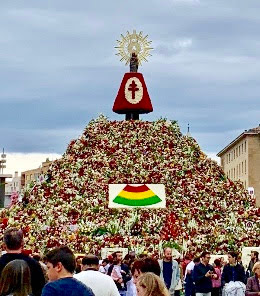
We arrived just as the last events from the Fiestas del Pilar were finishing up. This event is a 10 day festival honoring the Virgin with the last Saturday being the day of most importance: the Flower Offering. Flowers cover an enormous structure resembling a giant cloak. We did get to view this and many traditional costumes while in Zaragoza. Each day, leading to the Flower Offering, the festival features dramatic processions, and many special events. There were many stalls still open offering traditional food when we arrived. So, obviously, we ate. We also toured the cathedral and we were awed by the flower offerings in the main square before we made our way to Madrid.
Madrid

We were looking forward to a quick couple of days in Madrid, and once we found our way to the rental car drop off area at the Atocha Station (which was madness at the end of a long, Fiesta weekend here too), we easily found our way to our awesome AirBnB located near the Prada Museum. Since our time was short we did opt to do the Hop On, Hop off bus to get a overview of Spain’s Capital city. We stopped at the Royal Palace of Madrid and marveled over the immensity of its courtyard and beauty, matched by the adjacent Almudena Cathedral. We also strolled and dined at the historical St. Michael’s Market, while sampling a full bodied red wine as we went.
Madrid is a city that’s architecture parallels new and old, with impressive government buildings, museums that are world renowned, parks such as the royal Retiro, and a history that is full of persistence and determination. I wished we had had more time in this capital city.
Just for something fun, we went on a tour of the expansive Retiro Park, by Segway, much to my chagrin. Retiro Park used to be owned by the monarchy until it was given to the city for public use during the late 19th century. By Segway, we were able to view the many avenues, gardens, statues, ponds, and varied areas of beauty. We were able to view the former zoological area, the fragrant rose gardens, the peacock gardens, and the infamous Fountain of the Fallen Angel. The statue topping the fountains is said to be the only public monument featuring satan, as it is a detailed depiction of Lucifer falling from heaven after being cast out. We were fascinated to learn that the statue stands exactly 666 meters above sea level. We also stopped to pay tribute the Bald Cypress which is claimed to be the oldest tree in Madrid, once serving as a Cannon mount for French soldiers during the Napoleonic Wars in the early 19th century. It was just after that, that fate played an evil trick, possibly punishing me for my cocky Segway driving (as I really was rocking the Segway, honestly).





I will try a Segway again (said with stubborn determination). Somewhere in the future, long after this sprained heel has been physio-ed, I will prove that I am a Segway master, as I take the reigns of the wild beast once again. I did prevail over the Segway until in the last final moments when, upon going downhill, my Segway took on a mind of its own (or human error was made on feet placement combined with gravity on a hill) and it accelerated uncontrollably until I panicked and tried to jump off causing me to spectacularly crash. To my woe, my foot was quite hurt with massive soft tissue damage and I had to spend the rest of our 10 days riding in a wheelchair, and/or hobbling carefully around five other cities. Quite fittingly, I suppose, I soon earned the nickname, “La Reina” (queen) as I rode in my characteristic “carriage” aka wheelchair. Sigh. But I didn’t let this get me down. I was here to see Spain, and I would, and I did. And my hubby just got lucky enough to burn some of his extra calories off by pushing me around. Me, not so much.
Segovia

I read a catch phrase promoting Segovia that said, “Come for the palace, stay for the pork,” which struck me funny, especially considering this is where my hubby, Mike, and our friend, Angel, tried Morros. Morros is pig snout. Yup, pig snout cooked up in pieces in a tomato based sauce. Have you ever had canned beans and there is a gelatin piece of fat in with the beans for flavor? Morros is like that jiggly piece of fat. Let’s just say Louise and myself did not partake in this particular sampling of a Tapa. Actually, Segovia is famous for it’s Roast Suckling Pig.


That all being said, Segovia was my favorite city out of all the beautiful Spanish cities we visited. The old city of Segovia is on a hill rising up from a river edged by trails, bordered partly by an ancient massive Roman aqueduct with cobblestone narrow streets leading to the crowning glory of the Alcazar del Segovia.
Our AirBnBs just kept getting better and better with our Segovia apartment being only a ten minute walk to the aqueduct, featuring a designed space of quality furnishings and two bathrooms. Shortly after arriving, the men went to the tourist office and scored a wheelchair for only 5 euros a day, so we were ready to explore.
Every corner we turned we were presented with the most breathtaking buildings or views. The Roman Aqueduct, deservingly a UNESCO Heritage Site, is a miraculous engineering wonder and beautifully surreal to view. Built during the 1st Century, it’s purpose was to bring water 17 km from the mountains to the city, where is it believed to have had a distribution system. The Plaza Mayor, as each city has a main plaza in the center of the city, featured a historical hotel and cafes, a impressive cathedral that was the last Gothic cathedral built in Spain in 1525, and a gazebo for music. We also discovered by observing brass symbols found in the cobblestones, that these marked the Jewish Quarter, and an important part of Spain’s history. We also found these symbols in the Jewish quarters in Cordoba and Toledo. As is true in most Spanish cities, once dusk hit, the city comes alive with local life with families out for their meals, socializing and walking off their late meal with an evening stroll. We did as the Spanish do on our first day and evening, finding food and wine, and strolling the cobble-stoned streets. It was on our explorations that we discovered the not-so-secret cookie dispensary at the Convento de Corpus Christi.
My biggest disappointment in Madrid was not finding the off the beaten track cookie dispensary where cloistered nuns make and sell cookies made from ancient, secret cookie recipes. The mystique of this grabbed us and it would have been our adventure on our last morning in Madrid had I not been injured. But, as fate would have it, we had stumbled upon Segovia's own Nun Cookie dispensary. A small sign told us we would find 'Dulces que Sabe a Gloria en el Torno del Convento' which basically translates to 'Candy/Cookies that taste like Glory from the ovens of the convent'. We came back the next morning and were not disappointed. We were actually greeted at a small window, with a sliding panel, after pushing the buzzer, by the sweetest nun who asked us where we visiting from and gave us her suggestions to what cookies we should buy. We bought two types of "glorious" cookies, and loved our experience. Later on in Seville and Avila we were disappointed to see shops with cartoon-like nun pictures and dolls that sold "nun cookies" as well, making us that much more appreciative of our visit to Convento de Corpus Christi.


Touring the Alcazar de Segovia was a fairy tale like visit. This castle is THE castle that all children picture when they read stories of medieval times, sleeping beauties, wicked witches, royal love tales, and battles of knights and soldiers. It makes sense that this exact palace, along with the Neuschwanstein castle in Germany, were the main inspirations for Disney's Cinderella Castle. This castle is where Queen Isabella was educated, was later crowned and then spent much time ruling from, along with King Ferdinand. This powerful duo succeeded in bringing their kingdoms together creating, in turn, Spain. They do so while battling against forces to remain in power, bringing reform and security to their citizens, and being responsible for finding the new world by financing Christopher Columbus. And, Segovia was front and center during the birth of this country.


Comments